
Read the landscape
The Berlin Wall from Above: Reading a Divided Landscape
Read a 1989 aerial photograph of the Berlin Wall at Steinstücken. Separate visible border clues from the history supplied by the archive.
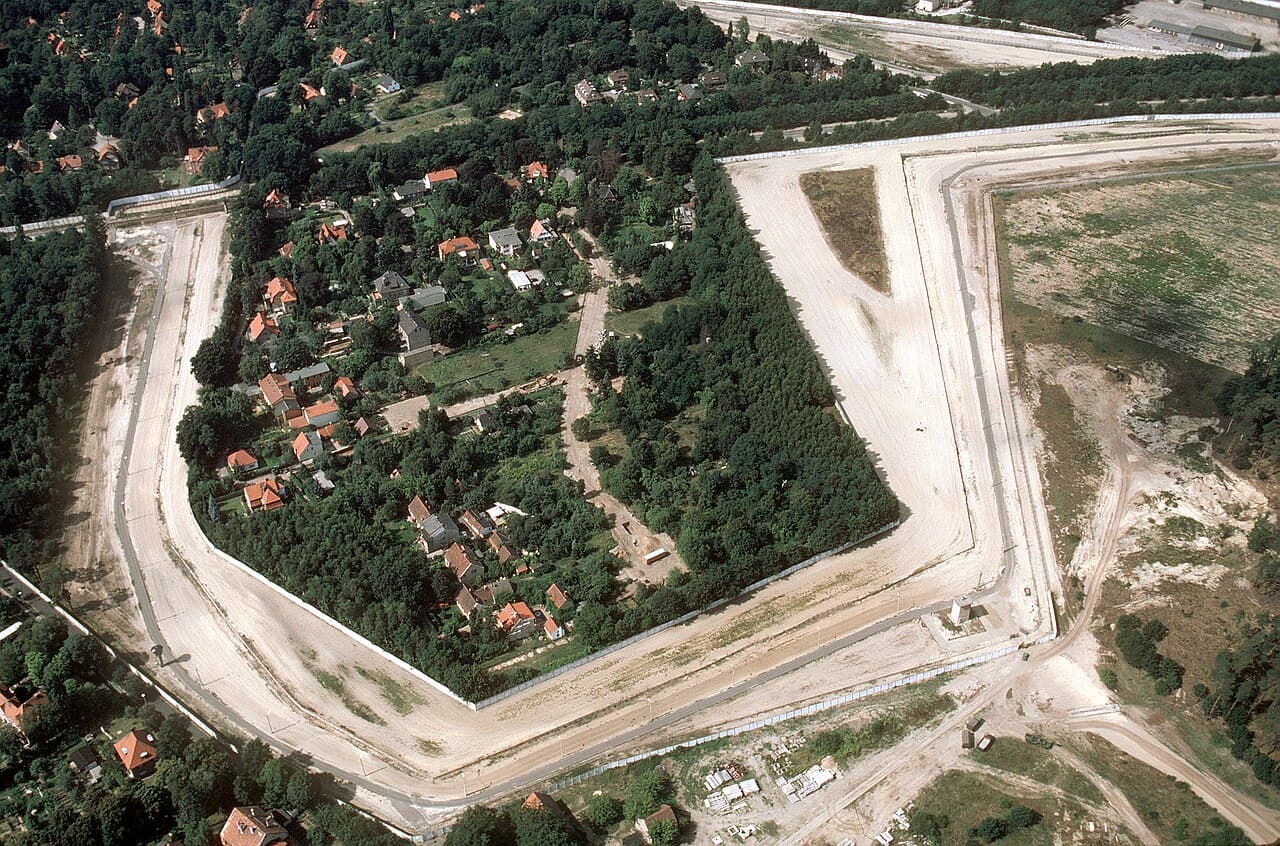
A section of the Berlin Wall around Steinstücken, recorded as 1989. Its strongest visible clue is the wide, controlled strip winding beside homes—not a famous city-center landmark. The year alone does not make this a photograph of the night the border opened.
This worked example reveals one photograph from our permanently public free introduction. It does not reveal the current daily challenge.

Follow the empty space, not just the wall
At first glance, the pale corridor could look like a road project. Trace it around the houses. It keeps a broad cleared area between barriers, follows sharp bends, and contains a narrower paved route. Those relationships make a controlled boundary a stronger hypothesis than an ordinary neighborhood street. That is an interpretation of the visible arrangement, not something the pale color proves.
The contrast at the edge
Trees and gardens occupy one side; a largely open strip borders them. Look for abrupt changes in how land is used. Empty space can carry as much information as buildings.
The repeated parallel lines
A wall, a route and another boundary travel together. Repeated elements suggest a system. A single isolated line would be much harder to interpret confidently.
The neighborhood’s outline
The strip wraps around residential blocks rather than following a simple straight avenue. Preserve that shape in your mental map before trying to name a place.
Why Steinstücken complicates the familiar Berlin map
The Berlin Wall Foundation’s history explains that Steinstücken belonged to West Berlin but was surrounded by East German territory. A territorial exchange in 1971–72 created a direct connection with the rest of West Berlin. This was a border landscape shaped by an unusual administrative boundary, not simply a line down the middle of the city.
The Foundation also describes the Wall as a system of barriers that developed over time. That context helps explain why the photograph shows a strip with several components. Do not label every small feature from memory: at this scale, some objects are too indistinct to identify securely.
For photo guessing, “Berlin Wall” is a starting point. Automatically choosing the Brandenburg Gate would discard the useful evidence in the neighborhood’s shape. A familiar subject can appear far from its most familiar viewpoint.
1989 is a year, not an event caption
The image record credits Don Sutherland and dates the photograph to 1989. Its listed date does not establish a day or month. The Foundation dates the opening of the border to 9 November 1989, but that separate historical fact must not be pasted onto every photograph made during the year.
Nor do leaves on trees establish an exact month. Vegetation may suggest a season; local weather, species and image processing limit how far that clue can go. There are no visible crowds opening a crossing in this frame. Describe the border you can see before assigning a dramatic event to it.
A quick evidence check
Which claim needs the archive rather than the pixels?
- The cleared strip bends around residential streets.
- The photograph was taken in 1989.
- The homes and trees contrast with the cleared ground.
Show the reasoning
The specific year comes from the image record. The other two statements describe visible relationships. If the date were hidden, this scene alone would not securely distinguish 1989 from every nearby year.
Carry the method into your first free game: trace a boundary, compare what lies on each side, and keep the observed scene separate from the story you remember. For a general map method, read how to find a photo’s location.
Sources and photograph credit
- Berlin Wall Foundation: border installations, Steinstücken and the Wall’s fall
- Wikimedia Commons: archived image credit, 1989 date and display-copy history
Historical facts above are attributed to these records. The observation exercises are our reading of the photograph; they are not additional archive claims. How we check and credit photos.
Your next clue is waiting.
Five photographs. Create a free account and start exploring.