
Find the when
How to date a historical photograph.
Build a plausible date range from the scene, test it against independent clues, then choose a year. The appearance of the digital image is only a starting point.
Use the newest reliably identified object to set an earliest possible date, and a documented change to set a latest possible date. Compare several clues before narrowing the range. The date of a scan, upload or restoration does not date the original scene.
Start with “after” and “before”
Guessing an exact year immediately can make everything else look like support for that guess. Start with a wider interval. A recognizable vehicle introduced in a known year can establish that the scene is no earlier than that year, provided the identification is right. It does not establish that the photograph was taken in the vehicle’s first year.
A building shown before a documented alteration can supply an upper bound. Use that carefully: a missing detail may simply be hidden, and a damaged building may have been repaired more than once. The useful range is where your strongest independent clues overlap.
Suppose a clearly identified bus design first appeared in 1956, and a building in the same scene still has a roof documented as removed in 1962. If both identifications hold, 1956–1962 is a defensible starting interval. A faded print adds no reason to move the date earlier. These dates illustrate the method; they are not an answer to a game photograph.
Give each clue the right amount of weight
| Clue | Useful inference | Common trap |
|---|---|---|
| A vehicle or machine | An earliest possible date if the model is identified securely. | Old vehicles remain in use; one car does not date a whole street. |
| A crowd’s clothing | A broad period supported by several people’s everyday dress. | Uniforms, costumes and ceremonial clothes may follow different timelines. |
| Construction or demolition | A narrower interval when the structure and stage are documented. | A skyline resemblance is not enough to identify a construction project. |
| A banner or dated poster | An event to investigate and compare with the rest of the scene. | The printed year may commemorate an earlier event. |
| Color, grain or fading | Information about the copy or photographic treatment. | Assuming color means recent, or black and white means early. |
Worked example: a flight, not an upload
This photograph is part of WhenWhere’s public introduction, so the example includes its answer.
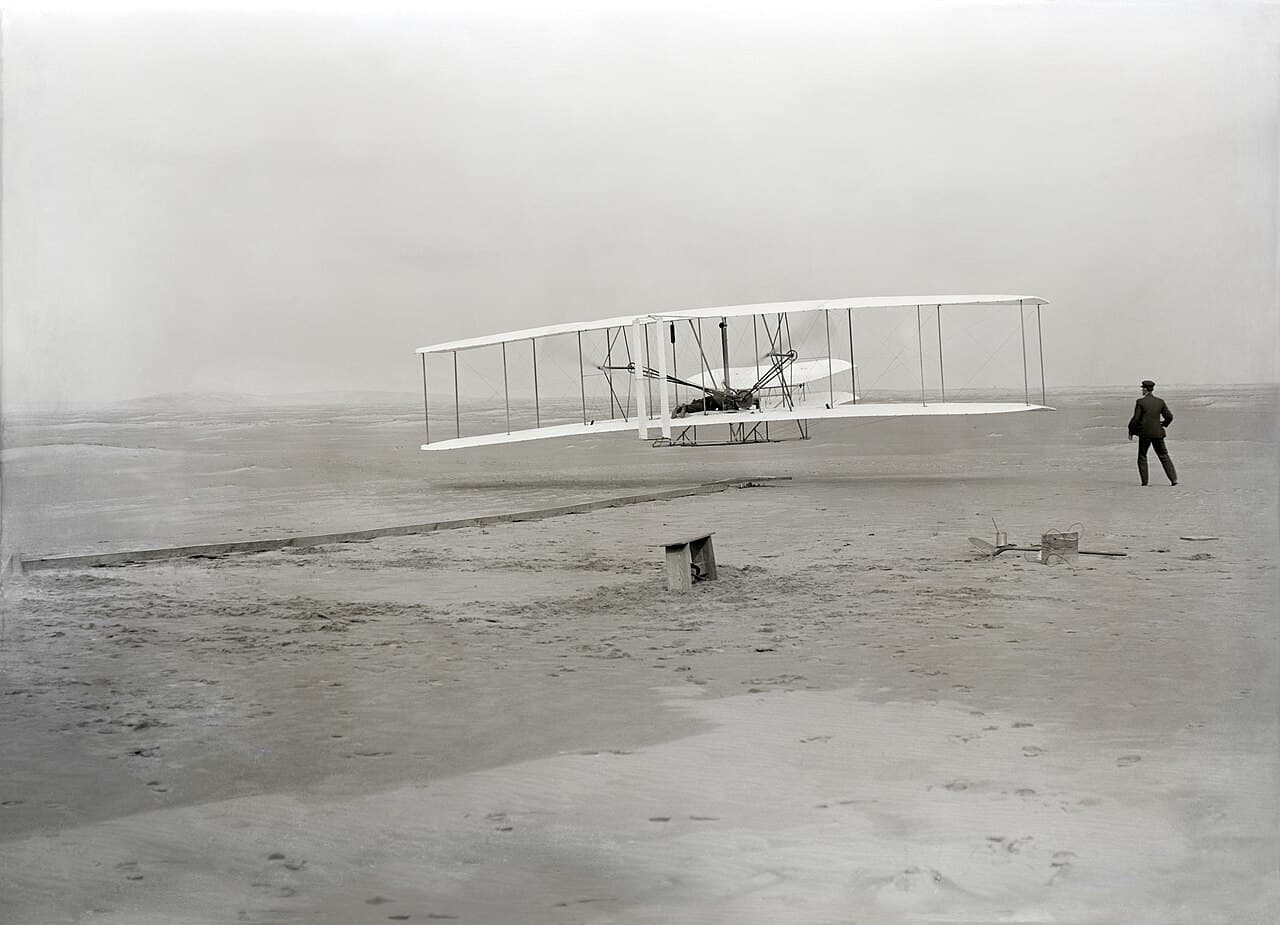

First observe the open aircraft frame, the rail across the sand and the person beside the machine. Together they suggest an early aviation experiment. None of those details alone proves a particular day. Recognizing the photograph gives a hypothesis that should still be checked against its record.
The record for this restored copy distinguishes the flight on 17 December 1903 from the later restoration in 2018. For the game, the answer is the year of the photographed event: 1903. A file-history timestamp describes the digital copy, not the moment in front of the lens.
The general lesson is to keep three things separate: what the scene suggests, what a source documents, and when the particular file was made. That distinction also helps with colorized copies and photographs reprinted decades later.
When two clues disagree, test the weaker claim
Suppose the clothing looks older than a vehicle. Before splitting the difference, ask whether the clothing is ceremonial, whether the vehicle is correctly identified, or whether you are looking at a later recreation. Two weak impressions do not become a strong fact by averaging them.
Look for another kind of evidence: signage, construction, street equipment or the source caption after the reveal. Several similar outfits are helpful context, but they are not as independent as clothing plus a documented building change. If nothing resolves the conflict, keep your uncertainty and make the best-supported estimate.
Turn the reveal into one useful lesson
After locking your answer, ask which clue most affected your estimate. Was it visible and specific, or something you filled in from memory? Follow the source link and distinguish an exact date from a catalog’s estimated date range. Do not turn an uncertain archive caption into false precision.
For a structured observation exercise, the National Archives photograph worksheet asks readers to describe the people, objects and activity, then explain the evidence behind their interpretation. You can use that habit during a round without consulting outside sources until the reveal.
WhenWhere scores time and place independently. See the year-scoring examples, then try the daily challenge with a date range in mind.
Your next clue is waiting.
Five photographs. Create a free account and start exploring.