
Read the occasion
Sydney Harbour Bridge, 1932: Reading an Opening-Day Photograph
Study Hall & Co.’s photograph of the Sydney Harbour Bridge opening on 19 March 1932. Learn what crowds, inscriptions and archive records can establish.
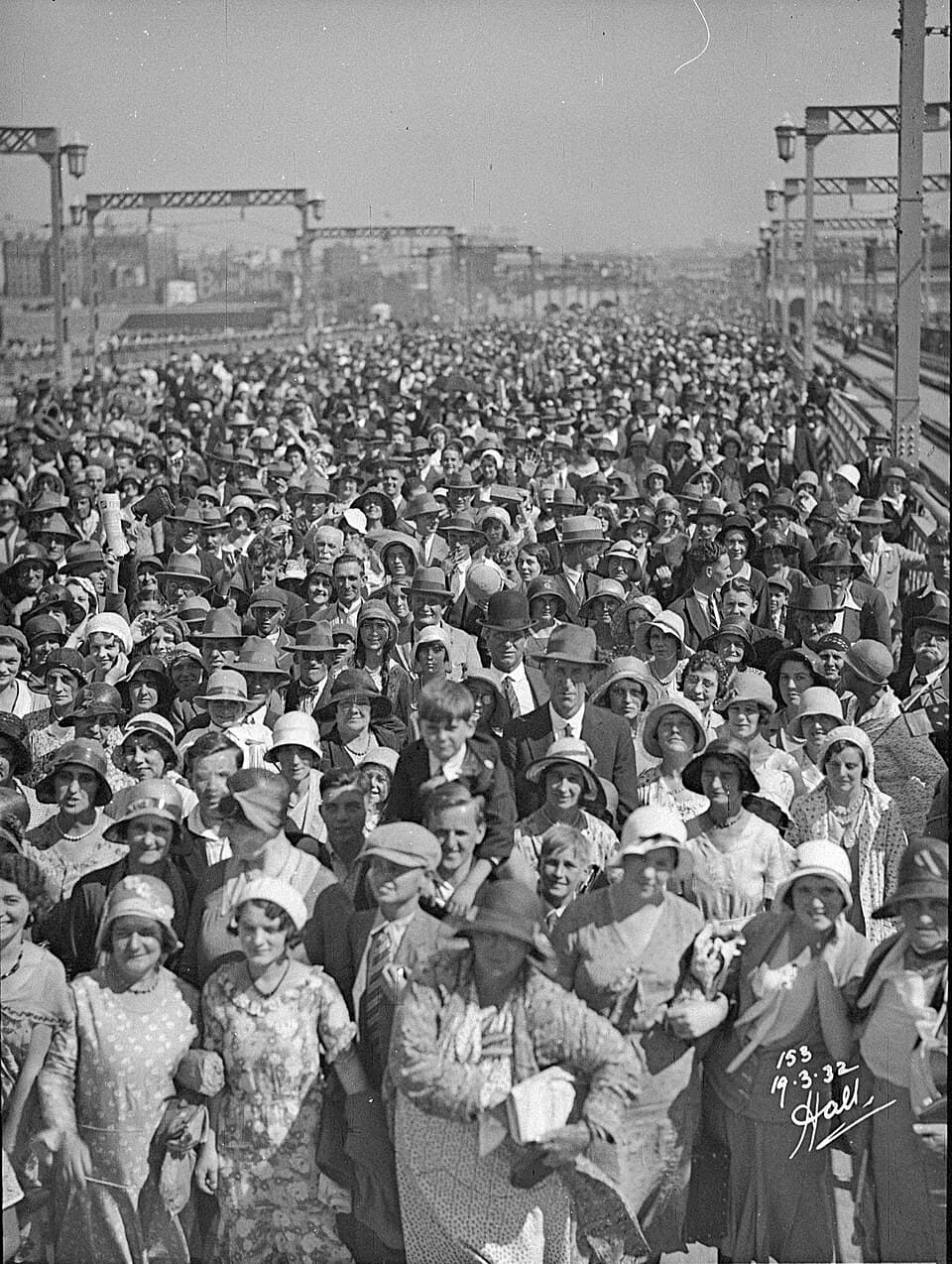
The official opening was on 19 March 1932. The State Library of New South Wales identifies this Hall & Co. photograph as a scene from that opening. Its value as a clue exercise is that the people dominate the picture; the bridge’s famous arch does not.
This worked example reveals one photograph from our permanently public free introduction. It does not reveal the current daily challenge.
A landmark does not always look like its postcard
Look at the sides and upper part of the image before concentrating on individual faces. Steelwork, railings and overhead supports form a route into the distance. People fill that route and many look toward the camera. Together, these details suggest a gathering on transport infrastructure, but they do not independently identify the bridge or the occasion.
Hats, coats and dresses give a broad impression of period. They cannot tell you the exact day, and a dense crowd does not by itself mean a protest, a parade or an opening. A good first description is deliberately literal: people gathered closely on a bridge deck. Leave the reason open until another clue supports it.
The Library’s own photograph page identifies the creator as Hall & Co., the date as 19 March 1932 and the collection reference as Home and Away – 38540. Those are source facts, rather than conclusions drawn from anyone’s clothing.
The date in the corner is a lead to check
At the lower right, the displayed copy carries the numerals 19·3·32 above a Hall signature. This is unusually useful, but the right habit is to corroborate an inscription, not treat every mark on an old photograph as an exposure date. Marks can describe a print, an event or later cataloging.
Here the inscription agrees with the Library’s dated identification. That agreement supports the opening-day reading. The digital publication is much later: the Library’s page separately lists an upload in 2024. Neither the upload date nor the age of the scan replaces the date of the photographed scene.
Where is the scene? What occasion brought people there? When was this particular image made? Recognizing a structure answers only the first question. A bridge can be photographed during construction, at an opening, or decades into ordinary use.
The ceremony has a history the crowd cannot tell you
The Library’s account of the opening ceremony describes Francis de Groot cutting the ribbon before Premier Jack Lang’s planned opening. That episode belongs to the day’s history; it is not depicted in this crowd photograph. Do not claim to see the ribbon incident, or identify a participant in it, simply because the source dates the image to the same day.
The distinction matters with any well-known event. A photograph of an audience can document attendance and appearance while leaving the central action outside the frame. A caption adds context; it does not make that missing action visible.
What would a tighter crop remove?
Imagine this photograph cropped to the central faces. Which two useful kinds of evidence would become harder to check?
Show the reasoning
You would lose much of the surrounding bridge structure and the dated inscription at the edge. The crowd would remain, but it would be harder to connect it to a specific place and occasion. Before zooming in, inspect the complete frame.
Try that routine in the free introduction: scan the edges, describe the scene, then enlarge one detail. Our beginner’s photo-clue guide gives you a repeatable way to combine those observations.
Sources and photograph credit
- State Library of NSW: this photograph, its date, creator and collection number
- State Library of NSW: the interrupted opening ceremony
- Wikimedia Commons: display-copy provenance and rights statement

Historical facts above are attributed to these records. The observation exercises are our reading of the photograph; they are not additional archive claims. How we check and credit photos.
Your next clue is waiting.
Five photographs. Create a free account and start exploring.