
Read two clues together
Planes over the Golden Gate Bridge: Reading a 1937 Photograph
Examine the Navy photograph of PBY aircraft over the Golden Gate Bridge in May 1937. Learn why a month, a landmark and an opening date are different clues.
The Navy caption reproduced with this image identifies PBY-1 patrol aircraft from VP-9 flying over the bridge’s southern end in May 1937. It gives a month, not an exact day. The bridge opened that month, but the photograph should not automatically be called an opening-day flyover.
This worked example reveals one photograph from our permanently public free introduction. It does not reveal the current daily challenge.
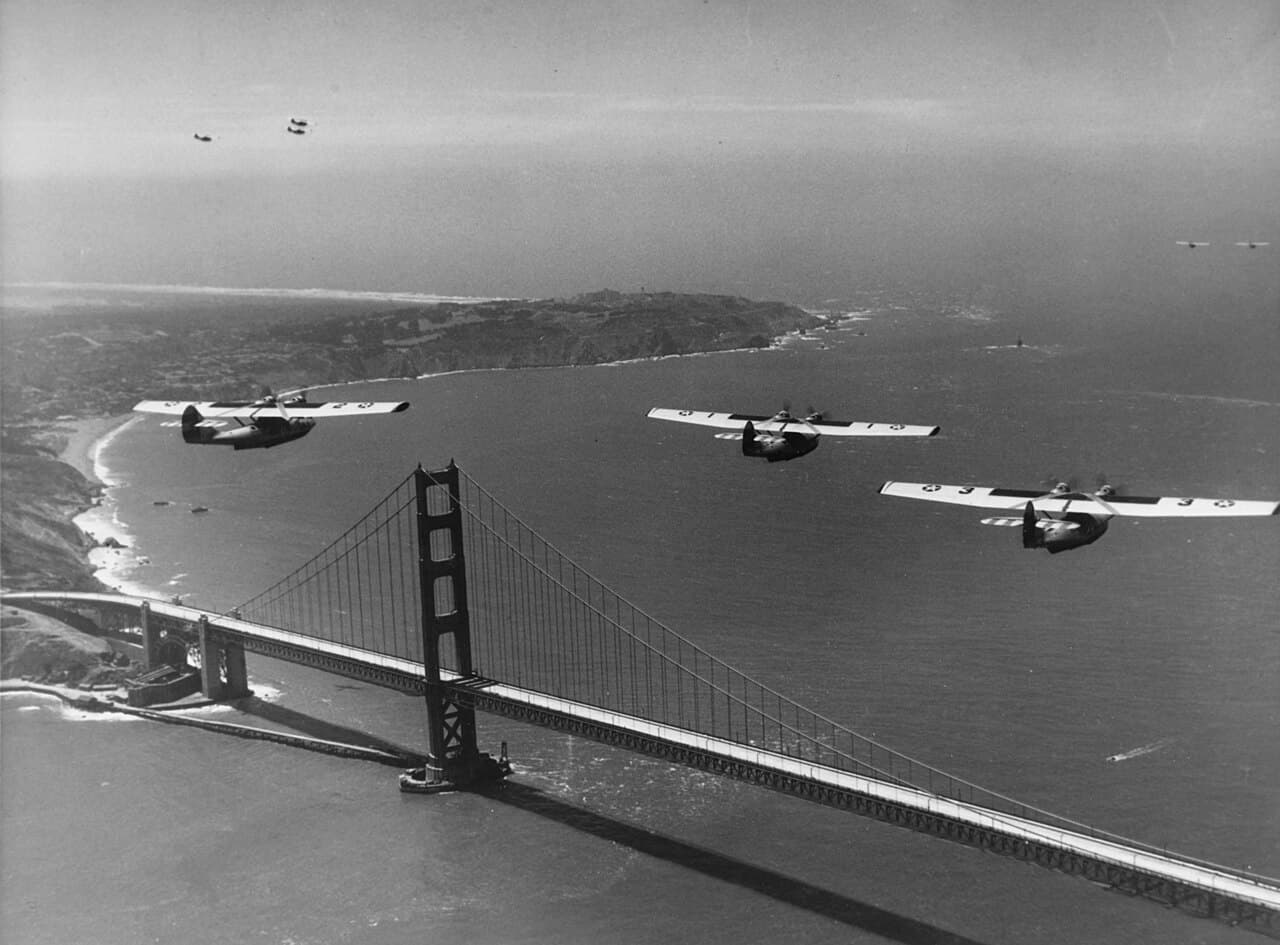

The largest object is not your only clue
Three aircraft dominate the foreground. Below them, cables descend from a suspension tower to the bridge deck; a curved shoreline and open water establish the setting. You do not need to identify an aircraft model immediately. Keep two lines of inquiry alive: the machines may narrow the period, while the bridge and coast may narrow the place.
Recognizing the Golden Gate Bridge is helpful, but a name alone does not date every image of it. Likewise, a military aircraft does not automatically place a photograph during a war. The Navy’s record for 80-G-418203 supplies the PBY-1 and VP-9 identification, as reproduced in the linked Commons image record. The bridge district’s history supplies the opening chronology below.
The useful skill is combining clues that answer different questions. Do not count “a recognizable tower” and “the same tower’s cables” as two independent proofs of the year. The aircraft and a dated bridge milestone would be different kinds of evidence—but each still needs a reliable identification.
A finished-looking bridge is not an opening-day timestamp
The bridge district’s chronology separates milestones that are easy to collapse into one date:
| Date | Documented event | What it does not prove |
|---|---|---|
| 19 April | Roadway paving completed. | Every view of the completed deck was taken that day. |
| 27 May | Bridge opened to pedestrians. | Every May photograph depicts Pedestrian Day. |
| 28 May | Bridge opened to vehicles. | A frame without visible traffic must predate the opening. |
The aircraft photograph’s caption notes the lack of traffic. That observation fits a question about the new bridge, but does not determine a day by itself. Distance, the part of the deck shown and the moment of exposure can all limit what you see. Keep the archive’s month-level date instead of upgrading it to false precision.
The subject and the camera are in different places
We look down on a bridge and across aircraft in flight. The image therefore gives an elevated viewpoint, while the catalog caption locates the action at the bridge’s southern end. Those are different spatial facts. This frame does not give a surveyed camera coordinate, altitude or bearing.
In a photo game, check what the answer represents. A documented landmark target is not necessarily the photographer’s position. WhenWhere’s location-accuracy guide explains that distinction and how uncertainty affects scoring. For this exercise, learning to separate the two is more valuable than inventing a precise point above the water.
Choose the caption the evidence supports
Which is better supported by the image record?
- Navy PBY-1 aircraft over the southern end of the Golden Gate Bridge, May 1937.
- The exact opening-day flyover at noon on 28 May 1937.
Show the reasoning
The first stays within the catalog caption. The second adds a day, time and occasion that the caption does not establish. A plausible connection is a research question, not a confirmed detail.
Ready to inspect another scene? The free five-photo introduction lets you try year and location guesses, then check the credited answer. Start with two different kinds of clue and see whether they support the same interpretation.
Sources and photograph credit
- Wikimedia Commons: Navy photograph 80-G-418203, reproduced caption and rights
- Golden Gate Bridge district: roadway completion and opening dates
Historical facts above are attributed to these records. The observation exercises are our reading of the photograph; they are not additional archive claims. How we check and credit photos.
Your next clue is waiting.
Five photographs. Create a free account and start exploring.